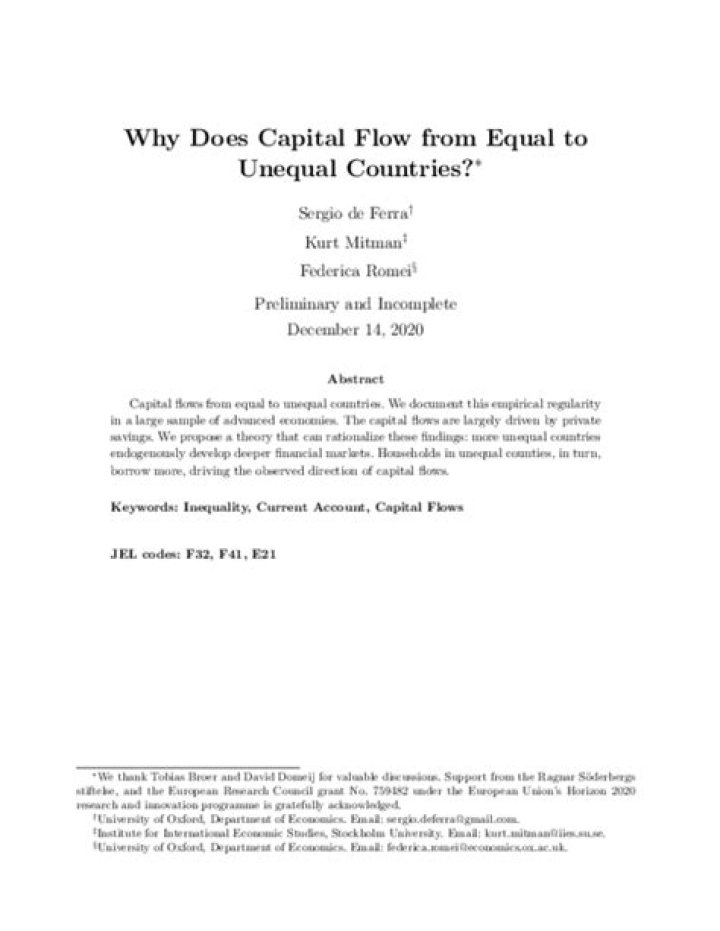
When residents of different countries can borrow and lend with each other, capital flows from equal to unequal countries, as savers in equal countries lend to borrowers in unequal countries.
Can the poor countries ever catch up with the rich countries?
The catch-up effect is a theory that all economies will eventually converge in terms of per capita income, due to the observation that poorer economies tend to grow more rapidly than wealthier economies. In other words, the poorer economies will literally “catch-up” to the more robust economies.
Why does capital flow among countries?
Capital flows from equal to unequal countries. The capital flows are largely driven by private savings. We propose a theory that can rationalize these findings: more unequal countries endogenously develop deeper financial markets.
Why are poor countries poor?
It is widely accepted that countries are poor because their economies don’t manage to grow sufficiently. Instead, countries are poor because they shrink too often, not because they cannot grow – and research suggests that only a few have the capacity to reduce incidences of economic shrinking.
Can all countries rich?
Originally Answered: Is it possible to have every country on Earth be rich and prosperous? Yes—in fact we are already well on the way. Based on United Nations and World Bank data, the share of the world’s population living in extreme poverty has declined from from 90% in 1820 to 10% today.
Which countries grow faster?
Nevertheless, here’s a look at the five fastest growing economies in 2021, based on IMF’s April 2021 projections.
- Libya. 2020: (59.72%) 2021: 130.98% 2022: 5.44%
- Macao SAR. 2020: (56.31%) 2021: 61.22% 2022: 43.04%
- Maldives. 2020: (32.24%) 2021: 18.87%
- Guyana. 2020: 43.38% 2021: 16.39%
- India. 2020: (7.97%) 2021: 12.55%
What affects capital flow?
Overall, various pull factors, or economic conditions and policies of the destination countries, seem to play an important role in attracting capital flows to emerging market economies, as institutional quality, financial openness, per capita income growth, change in stock market capitalization, and volatility of real …
Why is capital flow good?
What Explains Capital Flows? Capital flows between countries can yield significant benefits. They allow investors to diversify their risks and increase returns, and they allow residents of recipient countries to finance rapid rates of investment and economic growth, as well as to increase consumption.
Why does capital flow from poor to rich countries?
A country with a lower output-to-capital ratio will have a lower rate of return to capital – and the reverse holds as well. Such ratios are readily calculated, so it is straightforward to infer relative returns to capital from widely available data. Why poor to rich?
Why do poor countries save more than rich countries?
However, their savings rates have increased even more than their investment rates and the real puzzle has become: “Why do poor countries save so much?” Lucas, Robert (1990). “Why doesn’t Capital Flow from Rich to Poor Countries?”, The American Economic Review 80 (2): 92–96.
Why does a higher investment rate lower the capital to output ratio?
A higher investment rate raises the capital-to-output ratio, but a higher growth rate (or a higher rate of depreciation) increases the denominator and thus lowers the capital-to-output ratio.