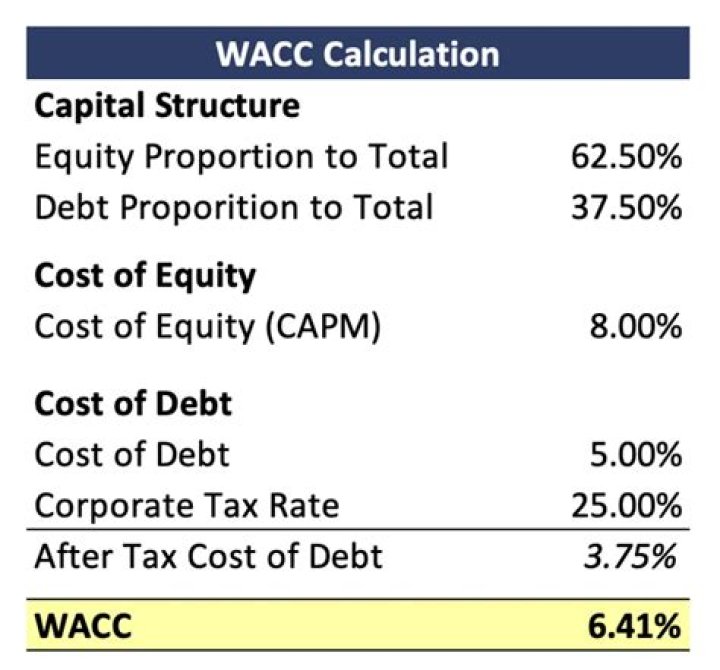
WACC is the average after-tax cost of a company’s various capital sources, including common stock, preferred stock, bonds, and any other long-term debt. They include raising money through listing their shares on the stock exchange (equity), or by issuing interest-paying bonds or taking commercial loans (debt).
Why do we use after-tax cost of debt in WACC?
The reason WHY we use after-tax cost of debt in calculating the WACC because we are interested in maximizing the value of the firm ‘ s stock, and the stock price depends on after-tax cash flows NOT before-tax cash flows. That is why we adjust the interest rate downward due to debt ‘ s preferential tax treatment.
What is the formula for cost of equity?
Using the capital asset pricing model (CAPM) to determine its cost of equity financing, you would apply Cost of Equity = Risk-Free Rate of Return + Beta × (Market Rate of Return – Risk-Free Rate of Return) to reach 1 + 1.1 × (10-1) = 10.9%.
How is pretax cost calculated?
The Excel sales tax decalculator works by using a formula that takes the following steps:
- Step 1: take the total price and divide it by one plus the tax rate.
- Step 2: multiply the result from step one by the tax rate to get the dollars of tax.
- Step 3: subtract the dollars of tax from step 2 from the total price.
Why do we use after-tax figure for cost of debt but not for cost of equity?
Why do we use aftertax figure for cost of debt but not for cost of equity? -Interest expense is tax-deductible. There is no difference between pretax and aftertax equity costs. Hence, if the YTM on outstanding bonds of the company is observed, the company has an accurate estimate of its cost of debt.
What is the difference between cost of debt and cost of equity?
The difference between before-tax cost of debt and after tax cost of debt is depended on the fact that interest expenses are deductible. It is an integral part of WACC i.e. weight average cost of capital. Cost of capital of the company is the sum of the cost of debt plus cost of equity. And Cost of debt is 1 minus tax rate into interest expense.
What’s the difference between before and after tax cost of debt?
Generally, it is referred to after-tax cost of debt. The difference between before-tax cost of debt and after tax cost of debt is depended on the fact that interest expenses are deductible. It is an integral part of WACC i.e. weight average cost of capital. Cost of capital of the company is the sum of the cost of debt plus cost of equity.
Which is a component of the cost of debt formula?
Cost of debt formula is a component of WACC i.e. Weighted average cost of capital. One can also calculate after-tax cost of debt to know the actual financial position of a company.
What’s the difference between debt and equity in WACC?
Debt is often secured by specific assets of the firm, while equity is not. In exchange for taking less risk, debtholders have a lower expected rate of return. WACC WACC is a firm’s Weighted Average Cost of Capital and represents its blended cost of capital including equity and debt. The WACC formula is = (E/V x Re) + ( (D/V x Rd) x (1-T)).