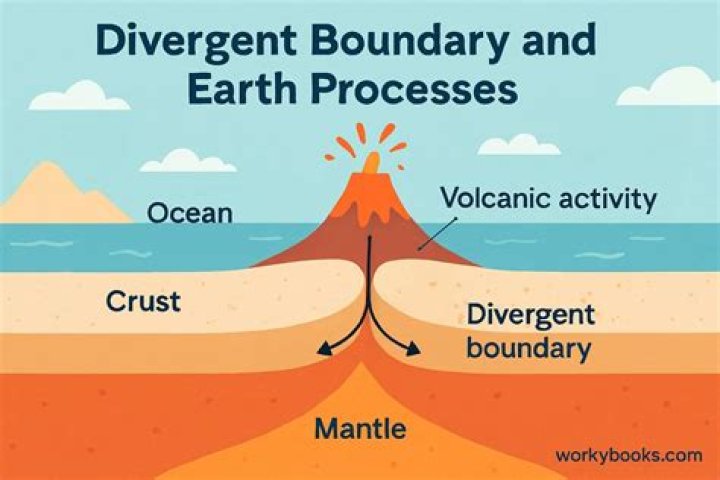
At a divergent boundary the plates move apart from each other as fresh magma rises to the surface to create new crustal material.
Are formed at divergent and convergent boundaries?
If two tectonic plates collide, they form a convergent plate boundary. When two plates are moving away from each other, we call this a divergent plate boundary. Along these boundaries, magma rises from deep within the Earth and erupts to form new crust on the lithosphere.
What are the similarities between convergent divergent and transform boundaries?
The similarities are that a boundary of any kind marks the line between two tectonic plates. Similarities between divergent and convergent boundaries include magma or lava flows, formation of new topographic features and re-shaping of landmasses.
What is an example of a convergent plate boundary?
Examples. The collision between the Eurasian Plate and the Indian Plate that is forming the Himalayas. Subduction of the northern part of the Pacific Plate and the NW North American Plate that is forming the Aleutian Islands. Subduction of the Nazca Plate beneath the South American Plate to form the Andes.
Do convergent boundaries cause volcanoes?
Sometimes, the plates collide with one another or move apart. Volcanoes are most common in these geologically active boundaries. The two types of plate boundaries that are most likely to produce volcanic activity are divergent plate boundaries and convergent plate boundaries.
What are two examples of convergent boundaries?
Examples of continent-continent convergent boundaries are the collision of the India Plate with the Eurasian Plate, creating the Himalaya Mountains, and the collision of the African Plate with the Eurasian Plate, creating the series of ranges extending from the Alps in Europe to the Zagros Mountains in Iran.
Which is the result of convergent, convergent and transform plate boundaries?
Inch by inch, this accounts for incredibly long distances over millions of years. Continents collide creating a supercontinent cycle. Then, they detach again into a new configuration. All the result of convergent, divergent and transform plate boundaries. This is a deep-dive into plate tectonics.
How are the different types of plate boundaries different?
Plate boundaries interact with each other in 3 primary ways. The types of plate tectonic boundaries are divergent, convergent, and transform (conservative). DIVERGENT PLATES: Divergent plates pull apart from each other. CONVERGENT PLATES: Convergent plates push boundaries together.
How are convergent boundaries formed in the mantle?
Convergent boundaries are boundaries where two plates are pushing into each other. They are formed when two plates collide, either crumpling up and forming mountains or pushing one of the plates under the other and back into the mantle to melt.
What happens when a continent is broken apart by a divergent boundary?
Rift valleys develop when a continent is broken apart by a divergent boundary. Now, as plates pull apart, several things may occur. First of all, volcanic activity is common in these areas since mantle easily moves to the surface through the thin, fractured rock as it separates.