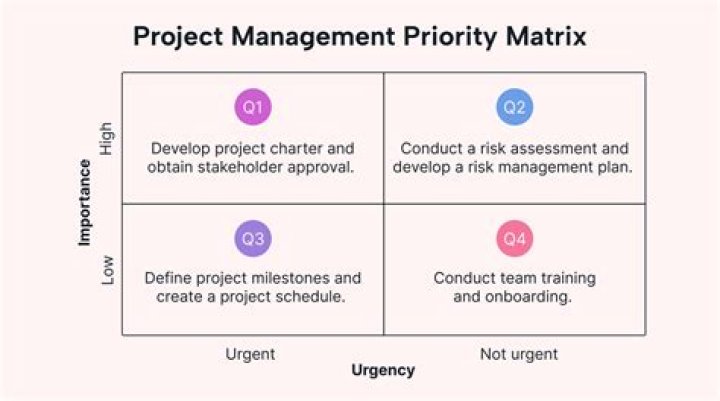
In the risk prioritization step, the overall set of identified risk events, their impact assessments, and their probabilities of occurrences are “processed” to derive a most-to-least-critical rank-order of identified risks. A major purpose of prioritizing risks is to form a basis for allocating resources.
Who should be doing risk analysis for the project?
The qualitative risk analysis is a risk assessment done by experts on the project teams, who use data from past projects and their expertise to estimate the impact and probability value for each risk on a scale or a risk matrix. The scale used is commonly ranked from zero to one.
Who should be appointed to own risk on a project?
A risk owner is any individual, generally a project team member, who is responsible for the management, monitoring and control of an identified risk, including the implementation of the selected responses.
What is risk prioritization?
Risk Prioritization — the ranking of material risks on an appropriate scale, such as frequency and/or severity.
How do you respond to risks?
Risk Responses
- Avoid – eliminate the threat to protect the project from the impact of the risk.
- Transfer – shifts the impact of the threat to as third party, together with ownership of the response.
- Mitigate – act to reduce the probability of occurrence or the impact of the risk.
How do you identify risks in a project?
There are many different techniques that can be used to identify project risks, including the following:
- Checklists.
- Lessons Learned.
- Subject Matter Experts.
- Documentation Review.
- SWOT Analysis.
- Brainstorming.
- Delphi Technique.
- Assumptions Analysis.
Who should be the owner of top risks?
A risk owner is a person or entity responsible for managing threats and vulnerabilities that they might exploit. The owner of each risk should be someone for whom the risk is relevant to their job and who has the authority to do something about it.
What is risk avoidance give an example?
Risk avoidance: This approach asks if the risk should be avoided. For example, the production of a proposed product is canceled because the danger inherent in the manufacturing process creates a risk that outweighs potential profits.
What are 2 ways you can respond to risks?
Risk Responses
- Avoid – eliminate the threat to protect the project from the impact of the risk.
- Transfer – shifts the impact of the threat to as third party, together with ownership of the response.
- Mitigate – act to reduce the probability of occurrence or the impact of the risk.
What are the possible risks in a project?
Here are 8 of the most common project risks that could threaten your project timeline, with some helpful advice to managing each and every one of them.
- Scope Risks.
- Cost Risks.
- Time Risks.
- Technology Risks.
- Resource Risks.
- Communication Risks.
- Procurement Risks.
- Miscellaneous Risks.
What are the responsibilities of risk owner?
The responsibilities of the risk owner are to ensure that: Risks are identified, assessed, managed and monitored. Appropriate level of risk tolerance is determined. Various internal stakeholders are assigned responsibility for each of the sub-risks identified within an enterprise risk.
What is the risk owner responsible for?
Who should be involved in identifying risks in project management?
The risk identification process on a project is typically one of brainstorming, and the usual rules of brainstorming apply: The full project team should be actively involved. Potential risks should be identified by all members of the project team. No criticism of any suggestion is permitted.
How do you manage project prioritization?
Here’s how to prioritize projects in 5 easy steps: Start prioritizing projects based on business value….
- Start prioritizing projects based on business value.
- Set priorities by identifying urgent and important projects.
- Assess your own bandwidth.
- Learn to say no to projects.
- Be flexible with the project prioritization process.
When should risks be avoided?
Risk is avoided when the organization refuses to accept it. The exposure is not permitted to come into existence. This is accomplished by simply not engaging in the action that gives rise to risk. If you do not want to risk losing your savings in a hazardous venture, then pick one where there is less risk.
7 Ways to Identify Project Risks
- Interviews. Select key stakeholders.
- Brainstorming. I will not go through the rules of brainstorming here.
- Checklists. See if your company has a list of the most common risks.
- Assumption Analysis.
- Cause and Effect Diagrams.
- Nominal Group Technique (NGT).
- Affinity Diagram.
How are risks prioritized in a risk management system?
In order to successfully mitigate risks, they must be prioritized based on their overall effect on the project. If every item that poses a potential risk to the project is considered high-priority, then the result is that nothing is a high priority because everything is considered equal.
What happens when everything is a high priority?
If every item that poses a potential risk to the project is considered high-priority, then the result is that nothing is a high priority because everything is considered equal. The major keys to reducing the impact of any risk to a project are to recognize, prioritize, and control.
When do you need to recognize a risk?
Recognizing Risk. Any event, large or small, can be considered a risk to a project if there is a chance it will impact the scope, schedule, or budget. It is important to examine all programs that are running concurrent with your project as well as within the project itself for any effects they may have.
When do you do a project risk assessment?
Risk Management – Recognizing and Prioritizing Project Risks. A project risk assessment is usually performed during project kickoff with all stakeholders contributing to the list of risks because the earlier in the project you plan for certain events, the lower the chances of the associated risks tend to be.