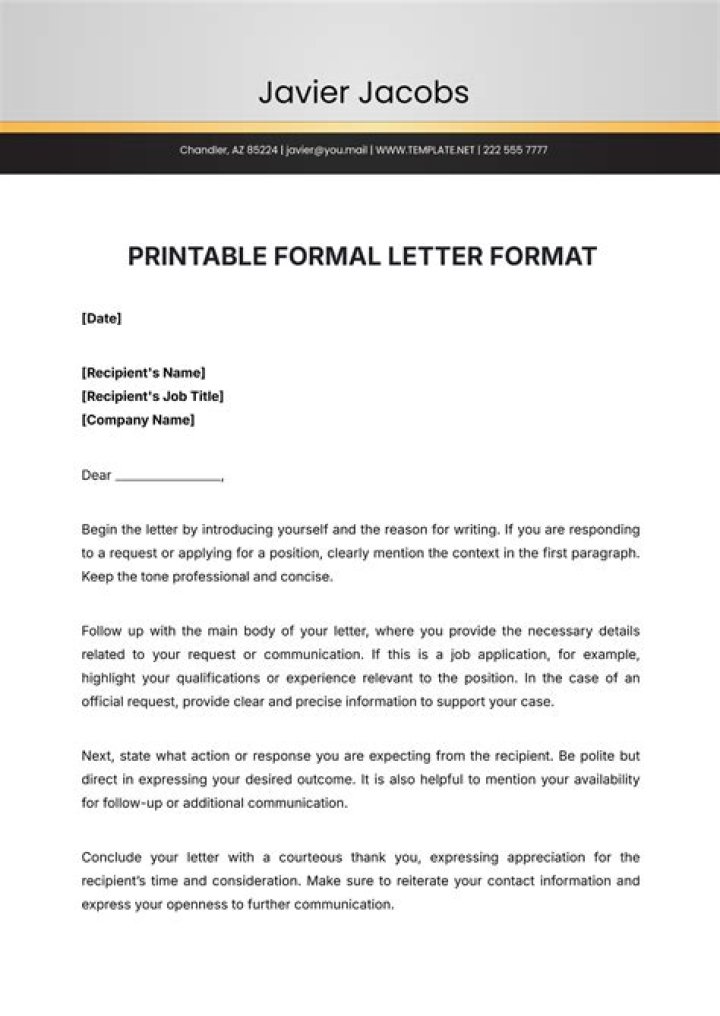
Formal Letter Format
- Sender’s Address.
- Date.
- Date.
- Name / Designation of Addressee.
- Address of the Addressee.
- Salutation.
- Subject.
- Body [Introduction, Content, Conclusion]
How do you structure a formal letter?
How to write a formal letter
- Write your name and contact information.
- Include the date.
- Include the recipient’s name and contact information.
- Write a subject line for AMS style.
- Write a salutation for block style.
- Write the body of the letter.
- Include a sign-off.
- Proofread your letter.
What is a good introduction sentence?
Your essay introduction should include three main things, in this order: An opening hook to catch the reader’s attention. Relevant background information that the reader needs to know. A thesis statement that presents your main point or argument.
Which is the correct format for a business letter?
In addition to the overall format and structure laid out above, you may also want to consider the following information, as standard business practices. Common formatting standards include: Arial, Times New Roman, or a similar standard font. Size 11 or 12 point. Sentence case capitalization. White background.
Where do you send a formal business letter?
In addition, formal business letters are usually printed and physically mailed to the address of the recipient. In this article, we explain the function of a business letter, when to use one and what the proper business letter format is to help you write your own.
What are the sections of a business letter?
Sections of a Business Letter Each section of your letter should adhere to the appropriate format, starting with your contact information and that of your recipient’s; salutation; the body of the letter; closing; and finally, your signature.
What is the correct font size for a business letter?
Use a plain font such as Arial, Times New Roman, Courier New, or Verdana. The font size should be 10 or 12 points. Leave a blank line after the salutation and before the closing. Business letters should always be printed on white bond paper rather than on colored paper or personal stationery.